

I’m not a fan of Rick Perry and am not posting this in order to defend him in any way. What irked me about the above article is not what it says about Perry, but what it says about our poor grasp of basic logic. If you find this article a compelling indictment of Perry’s hypocrisy or feel it is an embarrassing mistake on the part Perry’s campaign handles, think again. You’re missing the import of a single word: “but”.
I don’t doubt that Perry is opposed to homosexuals serving in the military and that he is for prayer in public schools but this article makes some glaring mistakes in order to make the buffoon look more buffoonish and in turn shows its own buffoonery. As I just mentioned, the word “but” is critical in the quote. The way it stands, it could mean that if gays are allowed the freedom to serve in the military, then school children should be allowed the freedom to pray in schools. In the quote provided Perry is not saying anything anti-gay; he is simply addressing an inequality of freedoms. The word “but” is offering a comparison, essentially “this is allowed but this isn’t” in an effort to point out an inequality, it doesn’t necessarily condemn either position.
But the poor logic doesn’t end at a conjunction, it goes deeper. Apparently they used some music from Aaron Copeland in Perry’s ad. Aaron Copeland was one of the best American composers. His Fanfare for the Common Man and Appalachian Spring are breathtakingly beautiful. He was also gay. The author of the cited article seems to think, and want us to think, that this somehow makes Perry a hypocrite. But stop for a moment. Perry may be saying that it is wrong for gays to serve in the military but that says nothing about it being right or wrong for gays to compose music. Perry’s ad isn’t saying that everything every gay person ever did is wrong but that is the way it is presented. I could be opposed to Islam and yet still appreciate and use Arabic numerals and algebra and not be a hypocrite.
One last twist to wrap the whole mess up in a nice bow. The person who posted the screen shot above has a screen name of “atheism-“. If it is wrong for Rick Perry to use Aaron Copeland’s music because Perry is (presumably) anti-gay and therefore must believe that anything originating form a homosexual is wrong, then the atheist must abandon science. Isaac Newton is, in many ways, the father of modern physics yet he wrote more Christian theology than he did physics. So if being religious means that you’re mentally deficient, and we apply the logical fallacy employed above, then our friend “atheism-” is equally as hypocritical if he or she embraces atheism for scientific reasons.
If you don’t like Rick Perry or his politics, nail him on where he’s wrong. There’s plenty of material there. But don’t launch into logical gerrymandering to make him look foolish. It backfires badly.

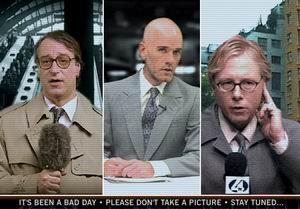 It is the one great weakness of journalism as a picture of our modern existence, that it must be a picture made up entirely of exceptions. We announce on flaring posters that a man has fallen off a scaffolding. We do not announce on flaring posters that a man has not fallen off a scaffolding. Yet this latter fact is fundamentally more exciting, as indicating that that moving tower of terror and mystery, a man, is still abroad upon the earth. That the man has not fallen off a scaffolding is really more sensational; and it is also some thousand times more common. But journalism cannot reasonably be expected thus to insist upon the permanent miracles. Busy editors cannot be expected to put on their posters, “Mr. Wilkinson Still Safe,” or “Mr. Jones, of Worthing, Not Dead Yet.” They cannot announce the happiness of mankind at all. They cannot describe all the forks that are not stolen, or all the marriages that are not judiciously dissolved. Hence the complete picture they give of life is of necessity fallacious; they can only represent what is unusual. However democratic they may be, they are only concerned with the minority. – G. K. Chesterton, The Ball and the Cross