
Archive for January, 2010

Is the American Church Really in Decline?

The numbers for the American church don’t look good:

  • Every year more than 4,000 churches close their doors compared to just over 1,000 new church starts.
  • Half of all churches in the US did not add any new members to their ranks in the last two years.
  • At the turn of the last century (1900), there was a ratio of 27 churches per 10,000 people, as compared to the close of this century (2000) where we have 11 churches per 10,000 people in America.
  • From 1990 to 2000, the combined membership of all Protestant denominations in the USA declined by almost 5 million members (9.5 percent), while the US population increased by 24 million (11 percent).
  • The United States now ranks third following China and India in the number of people who are not professing Christians.

But I wonder if these things are really bad. I know, I know, call me a “Pollyanna” but numbers are just numbers and Christianity is about God and his people. People often get hung up on numbers and miss other indicators of worth or health or progress. Bigger is better baby. My current church is growing. My previous church is plateaued. Other churches I know of are shrinking. Overall the American church is getting smaller. At the same time, I think there are some very encouraging signs within evangelicalism. But first, let me explain why (or try to) I think the numbers of American in church is going down and why that’s a good thing. Take a look at the ad to the left, you can click on it to get the whole thing. It is from the 1950s and here is the text:
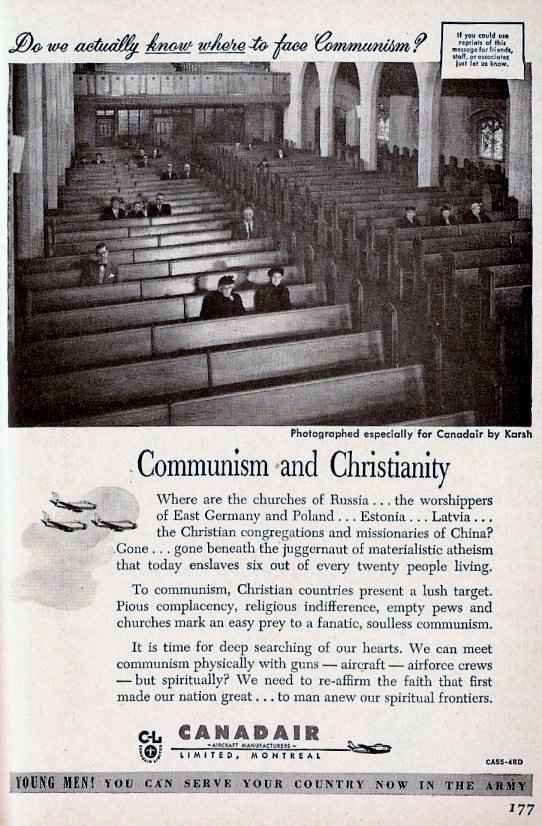
Where are the churches of Russia . . . the worshippers of East Germany and Poland . . . Estonia . . . Latvia . . the Christian congregations and missionaries of China? Gone . . . gone beneath the juggernaut of materialistic atheism that today enslaves six out of every twenty people living. To communism, Christian countries present a lush target. Pious complacency, religious indifference, empty pews and churches mark an easy prey to fanatic, soulless communism. It is time for deep searching of our hearts. We can meet communism physically with guns – aircraft – airforce crews – but spiritually? we need to re-affirm the faith that first made our nation great . . . to man anew our spiritual frontiers.

Why should you go to church? According to this ad, to defeat communism! They’re atheists and so we’re Christians. Get it? It is your patriotic duty to attend church this weekend! I heard a similar thing a few months ago when Scott Simon played some tapes of his father’s radio program from the 1950s. It was pretty much your patriotic duty to go to church. That kind of thing would really motive World War II vets and their families.

For a while, Christianity became customary, comfortable. It wasn’t dangerous or controversial, it was necessary to defeat Communism. In the 1960s the nation’s Christian moral values (ignored only in private) got questioned by long-haired, fist waving youth. Soon American Christianity slid into power politics as a way to maintain that moral edge and now it is misunderstood and loathed.

Accepted as necessary (but not embraced) ->
Questioned and dismissed (because it wasn’t really believed) ->
Struggling for power
(because it rode the coat tails of what came before) ->
Hated and misunderstood
(because the false part has largely fallen away).

Of course this is an incomplete picture of the history of Christianity in America as it really only covers the last half of the last century but I think it kind of explains where we are now. By way of illustration, I heard an interview with Hughes brothers, the directors of The Book of Eli. The one brother read the script and loved it. He pitched it to the other brother who said something about not being a true believer and being uncomfortable with the Bible having such a prominent place in the movie. Fair enough, but the line that caught my attention was when he said that it would be controversial to treat the Bible that way. That is, to treat it as important and of potential value to humanity. The first thing that came to my mind was “Excellent! We’re dangerous again!”

When Christianity was domesticated and used by society for reasons other than religious, it wasn’t dangerous. It formed a foundation for family values and the American way. People could take or leave the other aspects of the religion. I think this is why liberal Christianity flourished during that time. You could have religion without Christ.

This leads me to my point. It is a good thing that the church is shrinking in America. We’re not a house cat you can scratch between the ears and walk away from. The voices within Christianity who spoke only of religion as a positive societal force are now calling it dangerous and out of step and therefore are moving away. The field clears and you can better see who is who.

I don’t want to speak to absolutes here. Of course I don’t mean to say that all of the church in the 50s was weak and corrupt. Nor do I want to say that all of the church today is strong and effective. I’m only speaking of the general movement of the thing. And frankly I may be Pollyanna here. H. E. Barber of the Guardian in the UK visited America and didn’t have much good to say about evangelicalism:

If the trend identified in the Aris study continues, we will see a country divided between conservative evangelical Christians and secular liberals – the latter hostile to religious belief, identified with evangelical Christianity. This is bad news because popular evangelical Christianity is religiously vacuous…Saddleback [Church] is religion for people who don’t like religion: transcendence is not on the menu.

Although almost half of Americans say they have had a religious experience, mysticism is likely a recondite taste. For the minority who have that taste – who seek God as an object of contemplation – Saddleback has nothing.

Ouch. I mean, you have to take serious criticism from those outside the system. But at the same time, evangelicalism isn’t Saddleback Church. Most American churches are congregations of less than 200 and Saddleback is close to 120,000. It is far from representative of the norm. No, I’m comfortable with the American church getting smaller. It presents a richer harvest field where wheat and tares are easier to identify.

A Grace-filled Covenant of Works

Another name for Reformed Theology is Covenant Theology. The idea is that God relates to man through the structure of a covenant. Covenants are what structures redemptive history and even the intra-Trinitarian decision to redeem a people for God.  So when Covenant Theologians (myself included) look at redemptive history, we see an eternal covenant (Hebrews 13:20); a covenant with Noah to not destroy the world again with water; a covenant with Abraham that promises a land, a people and his seed to bless the nations; a covenant with Moses that shows many things about redemption and reconciliation with God; a covenant with David that promises and eternal king and the New Covenant where all these promises are enacted.

But many (most?) of us also see a covenant in the garden of Eden. A slightly smaller subset of us see two covenants in the garden. The second of the two covenants is the less controversial of the pair. Covenant Theologians call it the Covenant of Grace. God articulates this covenant after the fall when he cursed the serpent. In that curse he promised a victor over Satan, his scheme, and his minions. The way Covenant Theologians see it, this covenant is administrated or carried forward through the rest of God’s redemptive covenants. Incidentally, that is where the name of this blog comes from. The 1689 London Baptist Confession does a masterful job of articulating the covenant of grace. In the chapter on God’s Covenants it reads:

This covenant is revealed in the gospel; first of all to Adam in the promise of salvation by the seed of the woman, and afterwards by farther steps, until the full discovery thereof was completed in the New Testament…

As I’ve said, this covenant is the least controversial. The other one, the older one is less agreed upon. It is called the Covenant of Works and I think the name may be part of it’s problem.  Let me explain a bit and then defend some. The Covenant of Works is the covenant that God made with Adam when he created him and placed him in the garden. It is the covenant that Adam broke.  When God made Adam he made the garden of Eden for him and gave him one rule: Don’t eat from the Tree of the Knowledge of Good and Evil. That was it. He could climb in it, put a swing up in it, even build a tree fort and live in it if he wanted to. He just had to not eat the fruit of the tree. Next God created Eve and put both of them in the garden. It was Adam’s job to tell Eve this rule and they were set.  They had been created to live eternally and as long as they didn’t do that one thing they remained alive. That’s the Covenant of Works.

There are men whom I really respect who don’t agree with this. John Piper and John Murray are the big two who come to mind. 1For Piper though he doesn’t explicitly deny the Covenant of Works he seems to argue against it in Future Grace, p. 76. However, his website says that “he does see some merit in the concept of a pre-fall covenant of works, but he has not taken a position on their specific conception of the covenant of grace.” For Murray, see “The Adamic Administration” in his collected works, volume II. Having read their objections it seems to me that the definition of the Covenant of Works could be better termed. They both make decent points but neither really convinced me that the concept is wrong. A little defense is in order.

Hosea 6:7 says “But like Adam they transgressed the covenant; there they dealt faithlessly with me.” What this verse means is complicated and debated. I don’t want to really dig into it but just make a few observations. The phrase “like Adam” could be translated as “like mankind” (KJV) or “at Adam” (TNIV). The problem with taking “Adam” as “mankind” there is that all of humanity didn’t break a covenant with God. Or, if they did, it must have been done early on by a single representative like Adam in the garden. The problem with taking “Adam” as a place is that the only place in the Bible that “Adam” is a location is in Joshua 3:16 where God and Israel are being faithful to the covenant and not violating it.  This interpretation does have the fact that the second half over the verse says “there they dealt faithlessly with me” which would seem to indicate that God is referring to a location. But given the difficulty with taking the first half of the verse as a location, this seems unlikely. Perhaps the second half is not referring to the first but to the situation in Hosea’s time. The next verse begins by mentioning the city of Gilead, perhaps the second half of the verse is setting us up for what comes next. It seems best to recognize that Adam was in a covenant with God and that he violated it. The only covenant that could have been was the Covenant of Works.

But was the Covenant of Works a covenant of works righteousness or was it a grace-filled covenant? I’ve given that answer away in the title of this post. Consider this for a moment. Adam didn’t earn eternal life in that covenant, God granted it. Remember when God instituted the covenant he gave Adam one rule: don’t eat from that tree. But the Tree of the Knowledge of Good and Evil wasn’t the only special tree in the garden. There was another one called the Tree of Life and of that tree Adam and Eve were free to eat. It would provide them eternal life. After they’d fallen, God removed them from the garden because he feared that Adam might “reach out his hand and take also of the tree of life and eat, and live forever.” (Gen 3:22) How horrible would that have been to live eternally in a fallen state? Today we’d call that hell literally. So before the fall Adam and Eve had eternal life but after the fall it was removed from them and both the offer and the retraction were God’s grace.

1 For Piper though he doesn’t explicitly deny the Covenant of Works he seems to argue against it in Future Grace, p. 76. However, his website says that “he does see some merit in the concept of a pre-fall covenant of works, but he has not taken a position on their specific conception of the covenant of grace.” For Murray, see “The Adamic Administration” in his collected works, volume II.

Communion of the (Select) Saints

I hate to do a blog post that does nothing more than pick someone apart so I’m hoping that after I do some picking, I can actually make some helpful points. We’ll see.

Ada Chalhoun wrote a piece title “Secrets of a closet Christian” and the Chicago Sun-Times picked it up. The title and premise caught my attention. Ada is a (presumably) hip Brooklyner who, unbeknown to her friends, attends church. Why does she go to church?

It reminds you that, yes, those challenges are real and important and folks throughout history have struggled and thought about them too, and by the way, here is some profound writing on the subject from people whose whole job is to think about this stuff.

The idea of an eternal community brings me comfort…

No Jesus but not a horrible reason. I mean if she really is interested in historic Christianity, i.e. “eternal community”, then she may be in good place. We American Protestants, unlike the Reformers, sometimes forget that the church existed prior to 1517. I think we’re enriched if we remember the history of the church that Jesus is building. And if you go with broad Christian reading, you’ll get the gospel with the various emphasis it has had throughout the generations.

Tragically, that’s not where Ada goes at all.

It’s hard to talk about any of this without sounding dumb, or like a zealot or ridiculous. And who wants to be lumped in with all the other Christians, especially the ones you see on TV protesting gay marriage, giving money to charlatans and letting priests molest children?…

[The new atheists have been] mocking the dummies gullible enough to believe some guy a couple thousand years ago was God’s son. But come on. It’s like shooting Christian fish car magnets in a barrel.

I’ll give the atheists a lot: The Creation Museum is a riot. The psychos shooting up abortion clinics and telling gay couples they’re going to hell are evil and anyone of faith has an obligation to condemn them. Abominable stuff has been done in God’s name for centuries. Up with science and reason!

So I’m left wondering exactly who the “eternal community” is to her? The “dummies gullible enough to believe some guy a couple thousand years ago was God’s son” pretty much sums up and the rejects all of orthodox Christianity from St. Peter on. It even rejects Jesus himself. Her “communion of saints” begins at the turn of last century with very few going back to the 1700s. How tragic. She has no Jesus and really no community of faith so what do she have? Not much really.

On the other hand we have Brit Hume giving advice to Tiger Woods. Basically he said that Buddhism offers Tiger no forgiveness and no redemption. He tells Tiger to become a Christian. And he did it one network TV. And when asked about it later, he didn’t back down! What is this man thinking? In an interview with Christianity Today, Hume said, “I don’t want to practice a faith that I’m afraid to proclaim. I don’t want to be a closet Christian.”

Two things to close. First, Hume finds strength in the group where Calhoun wants to distance herself. Calhoun only wants to associate with the form of Christianity that won’t embarrass her or demand too much faith from her. This is what Hume said about having all kinds of Christians involved in his life after his son died. Compare it to Calhoun’s desire for isolation from the “unclean” and ask which one sounds more Christ-like:

My secretary and I were sending out notes to people that said, “Thank you for expressing your sympathy.” We sent out 973 sympathy notes in a matter of weeks. I read them all. My mailbox would be stuffed with them night after night. I’d weep over some of them. Some of them were prayer cards, some of them would tell me a tree had been planted somewhere. I felt that I was seeing the face of God. I felt people’s support and love. To me it was a miracle. I’ve been trying to face up to the implications of believing in Christ and believing in God ever since.

Second, Calhoun needs to hear Hume’s words about true Christianity. Christianity without the Son of God is limp and useless or worse.

Some people might say, “What about Christians like Ted Haggard or Mark Sanford?”

I don’t think I would blame Christianity for the failings of people like that. Christianity is the right religion for people like that. Christianity is a religion for sinners. Christianity is not about the salvation of perfect people. Christianity is a way for people who are not perfect to be saved. What Mark Sanford needs is not less Christianity. He needs more of it.

Evangelicalism Articles

I’ve been reading two very interesting articles that are not specifically about evangelicalism but both deal with the subject.  Since I want to end on a good note, I’ll handle my least favorite of the two first.

Why is there no joy in the Reformed camp asks Anthony Selvaggio over at the Reformation21 blog? Why it is all evangelicalism’s fault, of course! Check it out:

What attracted these immigrants were the things that they perceived as woefully deficient in evangelicalism. These included things such as irreverent worship, imprecise doctrine and sloppy to non-existent church government. In other words, most of the immigrants to the Reformed world made their migration because they were dissatisfied with evangelicalism. They were evangelical malcontents.

See? Since evangelicalism is a mess Reformed people are grumpy. Well, that’s not entirely it, I mean this is only the first of two points on the issue. But I think Anthony’s point here falls flat. Not because there is no goofiness in evangelicalism, there is. The reason is that the Reformed folks who didn’t emigrate weren’t very cheerful either when we got here.

But really, let’s change evangelicalism for your job. If you were at a job where everyone was happy but the place was poorly run and things seemed to change quarterly and you left that job and went to one where things were much more professional and run more orderly, would you be grumpy once you got there? I wouldn’t be.

So why are Reformed folks largely a grumpy lot? I’m not sure but I know that once I allowed my focus to move from Reformed Theology to the better view of God I got from my Reformed Theology, I had more joy. I wasn’t always happy but I found more joy. So perhaps the grumpiness comes from dogmatism. I’m not sure but that’s what it felt like for me.

The second article is a bit more upbeat about evangelicalism. It is a brief interview with Os Guinness over at the Evangel blog at First Things. Within the first few questions Guinness humbled me:

[Evangelicalism] is deeply written into the tradition of our family. My great great grandfather, who founded the Guinness Brewing Company, was an Evangelical and a friend of John Wesley, George Whitfield and was a strong supporter of William Wilberforce. So, the Evangelicalism that I know is not American Evangelicalism. People often think of Evangelicalism as the post-fundamentalism of the 1950s emergence under Billy Graham and Carl Henry.

Gulp. When I’ve taught on evangelicalism I’ve often said that it started with Graham and Henry but that isn’t exactly right. When Henry and others began to distance themselves from Fundamentalism they were originally called “neo-evangelicals” and according to Guinness for a good reason. Any way, Guinness is always interesting and often provocative. I recommend reading the interview. And if you want to know about the history of his family, Guinness stout and their relationship to Christianity, there is a book on it. I have it on my wish list and haven’t read it yet but I hope to.

Please Choose Your Comparisons Carefully

Something I read in two articles recently bothered me some. The first was a report on the next Chronicles of Narnia movie, “Voyage of the Dawn Treader”. The reporter was bothered that the Christian message of the book is being toned down in the movie. She mentioned that one of the producers was gay and pointed out how there would have never been an evangelical Christian in that position on “Milk”.

The other article was in the recent Christianity Today, a bio piece on Leslie Newbigin. The author pointed out the decline in people’s perception of evangelical Christians. The numbers are unimportant but it was something like only 3% of young people think positively of evangelicals as opposed to 33% who think that way of gays.

Here’s the problem. The opposite of evangelical Christian is not gay. The authors of these articles probably don’t mean it that way but that is how it comes across in the comparisons. It sets homosexuality as the opposite of being a Christian. I realize that homosexuality is the hot button issue these days and there is a battle over the definition of marriage. But by pitching the comparison this way a wall is created between gays and Christianity.

I’m not advocating homosexuality as an acceptable life style or anything. It is a sinful behavior but it is not the unpardonable sin that would exclude a person from the kingdom of Christ. By quickly picking our comparisons we may actually be creating a chasm between people who need Jesus and people who are charged to tell them about him.

So let’s be careful in our language. It really does mean something.